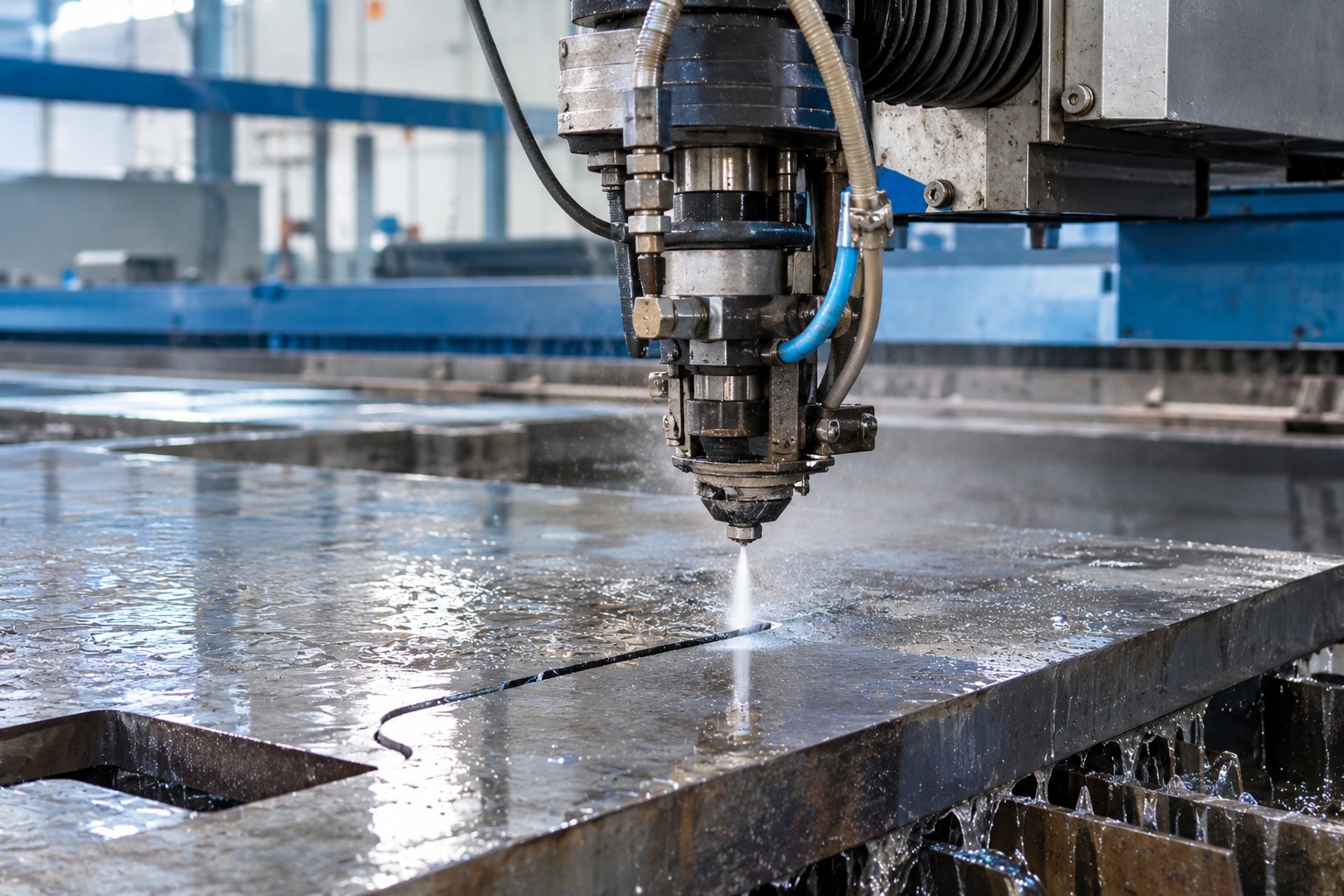
Yes. Abrasive waterjet cutting can cut thick steel without creating the heat-affected zone associated with thermal cutting processes. Instead of melting or burning through the metal, it uses a high-pressure stream of water mixed with abrasive particles to erode the material along a programmed cutting path.
This makes waterjet cutting a valuable option for Australian manufacturers, engineers and metal fabricators working with thick steel plates, intricate profiles and components where material integrity matters.
Heat from conventional cutting methods can affect the area surrounding the cut. Depending on the material and process, this may lead to localised changes in hardness, residual stresses, discolouration or thermal distortion. Waterjet cutting avoids the thermal cutting mechanism, making it particularly useful when heat-related changes need to be minimised.
However, choosing the right cutting process involves more than avoiding heat. Material thickness, dimensional tolerances, profile complexity, production time and finishing requirements also influence the result.
In this guide, we explain how waterjet cutting works on thick steel, why it is used for precision manufacturing, and what Australian businesses should consider before choosing a waterjet cutting service.
How Does Waterjet Cutting Work on Thick Steel?
Waterjet cutting uses a highly pressurised stream of water directed through a specialised cutting head. When cutting steel, an abrasive material is introduced into the water stream to increase its cutting ability.
The abrasive particles remove material through erosion as the cutting head follows a programmed path. This allows the machine to create profiles, holes and intricate shapes without relying on a conventional mechanical cutting blade.
The process generally involves four stages:
- Design: The required component is prepared using CAD drawings or a compatible digital design file.
- Programming: The cutting path is created and optimised according to the material, thickness and required geometry.
- Cutting: The abrasive waterjet follows the programmed path to cut the steel plate.
- Inspection: The finished component is checked against the drawing, dimensions and specified quality requirements.
This process is useful for manufacturing components with complex two-dimensional profiles, including brackets, plates, machine parts and custom engineering components.
For thick steel, the cutting settings and machine capability are especially important. Material grade, plate thickness, cutting speed and required edge quality all influence the final result.
Why Does Waterjet Cutting Thick Steel Avoid Heat Distortion?
One of the main advantages of waterjet cutting thick steel is that it removes material mechanically rather than melting it with a concentrated heat source.
Thermal processes, including laser, plasma and oxy-fuel cutting, use heat to separate material. Depending on the process and application, this can produce a heat-affected zone or cause localised expansion and contraction.
Abrasive waterjet cutting works differently. The high-speed water and abrasive stream erodes the steel, while the water helps carry heat away from the cutting area.
As a result, waterjet cutting does not produce the conventional heat-affected zone associated with thermal cutting.
This matters when manufacturing components that require consistent material properties or precise geometry.
Potential advantages include:
- No conventional heat-affected zone: The cutting process does not create the thermally altered edge zone associated with laser or plasma cutting.
- Reduced risk of thermal distortion: The absence of concentrated cutting heat helps minimise heat-related warping.
- Preservation of material properties near the cut: The process avoids the local thermal changes that can occur during hot cutting.
- Flexibility for heat-sensitive applications: Waterjet cutting can be suitable for components where thermal effects are undesirable.
It is important to distinguish thermal distortion from every other form of dimensional variation. Waterjet cutting can still produce edge taper, dimensional deviations or other quality variations depending on the machine, material, cutting settings and geometry.
For critical components, confirm the required tolerances with the cutting provider and inspect the finished part against the engineering drawing.
What Thickness of Steel Can Waterjet Cutting Handle?
Waterjet cutting is suitable for a wide range of steel plate thicknesses, but the maximum practical thickness depends on the machine, material, cutting speed and required finish.
Blue Water Engineering states that its waterjet cutting service can process materials up to 150 mm thick, with sheet sizes up to 4 metres by 2 metres. Actual suitability should be confirmed for the specific material and component.
The ability to cut a particular thickness does not automatically guarantee that every profile can be produced at the same speed, tolerance or edge quality.
Before selecting a waterjet cutting service for thick steel, consider the following factors:
1. Steel Grade and Material Properties
Different grades of steel have different mechanical properties. The material grade should be provided when requesting a quote so the cutting provider can assess the application.
2. Plate Thickness
Thicker material generally requires more cutting time than thinner plate. Cutting speed and edge quality must be balanced against the production schedule and project requirements.
3. Component Geometry
Simple profiles and intricate designs can require different programming and cutting strategies. Small internal features, narrow sections and complex contours may influence achievable results.
4. Required Tolerances
Not every component requires the same dimensional accuracy. Identify critical dimensions and tolerances on the engineering drawing before production begins.
5. Surface Finish and Secondary Operations
Some components may require additional machining, deburring, cleaning or finishing after cutting. These requirements should be considered when comparing manufacturing options.
For businesses searching for waterjet cutting services in Australia, providing complete drawings and material specifications helps the supplier assess the job more accurately.
Waterjet Cutting vs Laser Cutting for Thick Steel
Waterjet and laser cutting are both computer-controlled manufacturing processes, but they work differently and suit different applications.
| Requirement | Abrasive Waterjet Cutting | Laser Cutting |
|---|---|---|
| Cutting method | High-pressure water and abrasive erosion | Concentrated laser energy |
| Heat-affected zone | No conventional thermal heat-affected zone | May produce a heat-affected zone |
| Thick steel | Suitable within the machine's rated capacity and practical cutting limits | Depends on laser type, power, material and thickness |
| Complex profiles | Suitable for intricate two-dimensional profiles | Also suitable for detailed profiles |
| Thermal distortion | Minimises distortion caused by cutting heat | Heat input may cause thermal distortion in some applications |
| Best process | Depends on thickness, tolerances, material and production requirements | Depends on thickness, speed, edge quality and production requirements |
Waterjet cutting can be a strong choice when the job requires cold cutting, involves thicker plate within the machine's capability, or uses materials that should not be exposed to cutting heat.
Laser cutting may be preferable for other applications, particularly when high cutting speed and efficient processing of suitable sheet materials are priorities.
Neither method is universally better. The right choice depends on the part's material, thickness, geometry, tolerance requirements and total production cost.
What Are the Benefits of Precision Waterjet Cutting for Australian Manufacturers?
For Australian engineering businesses, manufacturers and fabricators, precision waterjet cutting can offer several practical benefits.
1. Complex Component Profiles
CNC-controlled cutting allows intricate shapes to be produced from digital drawings. This is useful for custom brackets, plates, machine components and other engineered parts.
2. Reduced Heat-Related Material Changes
Because abrasive waterjet cutting does not rely on melting the steel, it can help avoid heat-related changes near the cut edge.
3. Material Versatility
Waterjet technology can process a broad range of materials, including mild steel, stainless steel, aluminium and various non-metal materials, subject to machine capability and application requirements.
4. Efficient Material Use
The cutting path and part layout can be planned to use sheet material efficiently. Nesting suitable components together may help reduce avoidable scrap, depending on the job design.
5. Integration with Other Manufacturing Processes
Some components require more than cutting alone. A part may need CNC machining for precision holes or threads, followed by welding or fabrication to create a finished assembly.
Using compatible manufacturing processes together can help simplify production planning and reduce unnecessary handling between suppliers.
For Australian businesses, these advantages can be relevant to industrial equipment, custom engineering, fabrication and component manufacturing projects.
How to Choose a Waterjet Cutting Service in Australia
Selecting a supplier involves more than comparing the quoted price. The provider needs enough technical information to determine whether the equipment and process are appropriate for the job.
Use this checklist before requesting a quote:
- Provide accurate engineering drawings: Include dimensions, holes, openings, angles, critical tolerances and any other features that affect the finished component.
- Specify the material: State the steel grade, thickness and any relevant material requirements.
- Identify critical dimensions: Mark the dimensions that must be controlled carefully so the supplier can assess the manufacturing requirements.
- Explain the intended application: Let the supplier know how the part will be used, especially if edge condition, heat treatment or downstream welding is important.
- Confirm the required quantity: Prototype parts, one-off components and larger production runs can have different cost and scheduling considerations.
- Discuss finishing requirements: Identify any deburring, machining, coating or fabrication needed after cutting.
- Check delivery and support: Confirm lead times, transport arrangements and whether the supplier can support additional manufacturing stages.
Blue Water Engineering offers CNC waterjet cutting alongside machining, fabrication and CAD drawing services. Its website describes capabilities serving customers in Queensland, across Australia and overseas. These services may be relevant to businesses seeking a coordinated approach to custom component manufacturing.
To assess a project, provide the drawing, material details, required quantity and delivery timeframe when contacting the company.
When Should You Choose Waterjet Cutting for Thick Steel?
Waterjet cutting is worth considering when a component needs a complex profile, when cutting heat should be avoided, or when the material and thickness suit the available equipment.
It can be particularly useful for:
- Thick steel plate components within the machine's rated capability.
- Intricate two-dimensional profiles.
- Parts where a conventional heat-affected zone is undesirable.
- Custom engineering components made to supplied drawings.
- Projects that combine cutting with machining or fabrication.
However, if a component needs threaded holes, precision pockets or complex three-dimensional features, waterjet cutting may be only one stage of the manufacturing process.
Discuss the complete part requirements with the supplier before deciding on the production method. A technical assessment can help establish whether waterjet cutting alone is suitable or whether a combination of processes is more appropriate.
Frequently Asked Questions About Waterjet Cutting Thick Steel
1. Can waterjet cutting cut thick steel without heat distortion?
Yes. Abrasive waterjet cutting removes steel through mechanical erosion rather than melting it. This avoids the conventional heat-affected zone associated with thermal cutting and helps minimise heat-related distortion. Dimensional accuracy still depends on the material, machine settings, geometry and required tolerance.
2. What thickness of steel can waterjet cutting cut?
The practical maximum depends on the machine, material and required cut quality. Blue Water Engineering states that its waterjet service can cut materials up to 150 mm thick. Confirm the suitability of your particular steel grade, thickness and profile before placing an order.
3. Is waterjet cutting better than laser cutting for thick steel?
It depends on the application. Waterjet cutting avoids the conventional thermal heat-affected zone and can suit thick plate within the machine's capability. Laser cutting may offer advantages in speed for suitable materials and thicknesses. Compare the required tolerance, edge finish, production time and overall cost.
4. Does waterjet cutting change the properties of steel?
Because abrasive waterjet cutting does not use a concentrated heat source to melt the steel, it avoids the thermal changes normally associated with a heat-affected zone. Other material or manufacturing considerations may still matter, so critical components should be assessed against their engineering requirements.
5. What industries use waterjet cutting in Australia?
Waterjet cutting can be used in engineering, industrial manufacturing, metal fabrication, equipment production and other applications requiring profiles cut from compatible sheet or plate materials. Suitability depends on the part, material and required specifications.
6. Is waterjet cutting accurate enough for engineering components?
Waterjet cutting can produce intricate profiles and accurate components, but achievable tolerances depend on material thickness, geometry, machine capability and cutting settings. Provide the required tolerances on the drawing and confirm them with the supplier before production.
7. What information is needed for a waterjet cutting quote?
Provide a CAD drawing or dimensioned engineering drawing, material type and grade, thickness, quantity, required tolerances, finishing requirements and delivery timeframe. These details help the supplier evaluate feasibility and prepare a more relevant quote.
8. Can waterjet-cut steel components be machined or fabricated afterwards?
Yes. Depending on the design, a waterjet-cut component may undergo CNC machining, welding, fabrication or finishing. The most suitable process sequence depends on the part's geometry, tolerances and final application.
Conclusion: Find the Right Waterjet Cutting Solution for Thick Steel
Can waterjet cutting cut thick steel without heat distortion? Yes—abrasive waterjet cutting avoids the conventional heat-affected zone created by thermal cutting methods and can help minimise heat-related warping.
For Australian manufacturers, the process offers a useful option for thick steel plates, complex profiles and components where material integrity is important. However, the right solution depends on more than thickness alone. Material grade, geometry, cutting quality, tolerances and downstream manufacturing requirements all need to be considered.
Before choosing a cutting method, prepare accurate drawings and clearly identify your material and production requirements. A supplier can then assess the job and recommend an appropriate manufacturing approach.
If your business needs precision steel plate cutting or custom engineering components, explore Blue Water Engineering's waterjet cutting services and contact us to submit your project details for a technical assessment and quote.