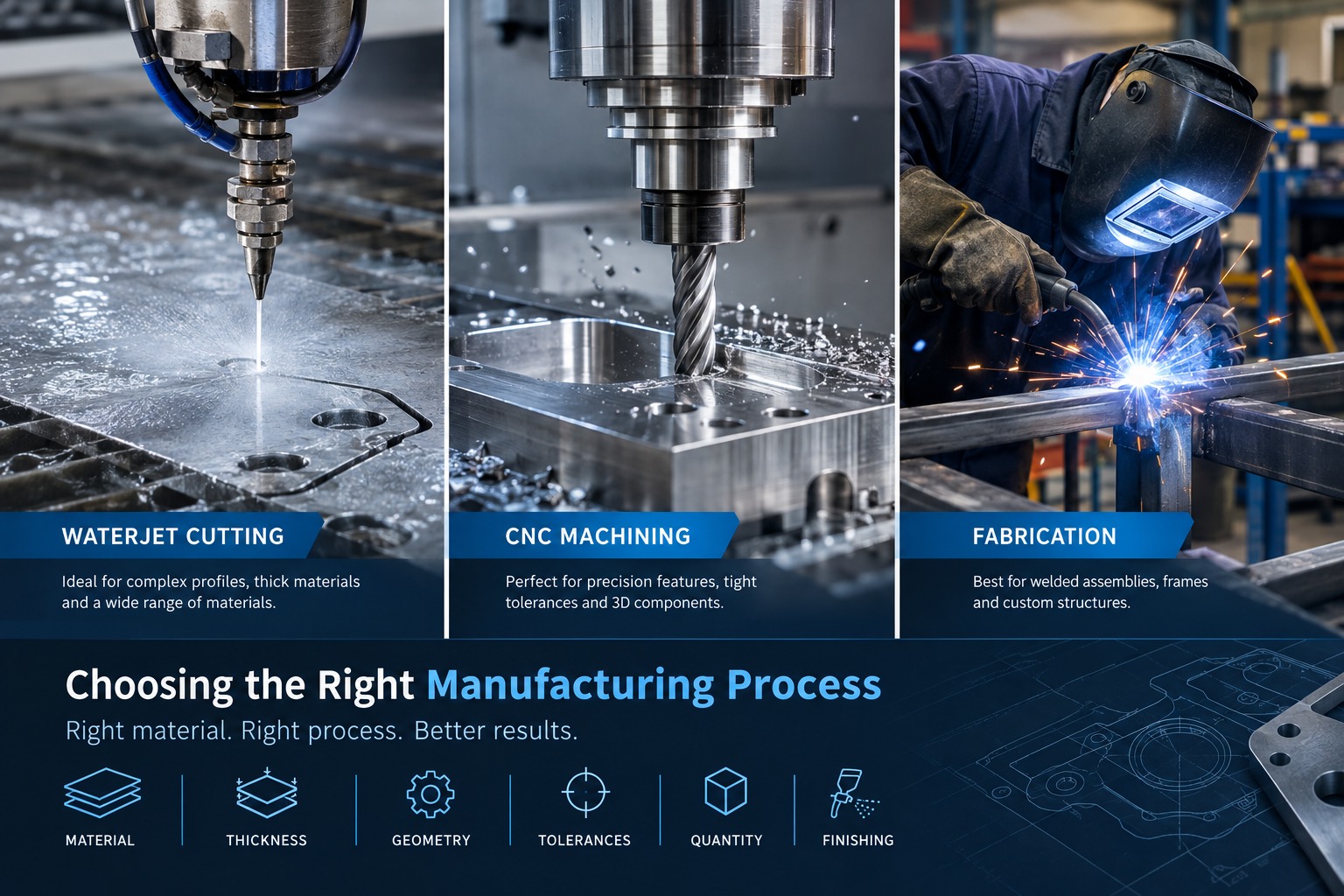
Choosing the right manufacturing process can affect the cost, accuracy, lead time and performance of a custom component. For many engineering projects, the choice comes down to waterjet cutting, CNC machining or metal fabrication.
So, which process should you choose?
The answer depends on the material, thickness, geometry, tolerances, quantity and finishing requirements of the component.
Blue Water Engineering provides waterjet cutting, CNC machining, metal fabrication and 2D/3D CAD services, supporting projects in Australia and internationally.
Waterjet Cutting vs CNC Machining vs Fabrication: What's the Difference?
In simple terms:
- Waterjet cutting creates accurate profiles from sheet and plate using high-pressure water and abrasive.
- CNC machining removes material using computer-controlled cutting tools to create precise features.
- Metal fabrication involves cutting, forming, welding and assembling components into a finished structure.
The right process depends on the requirements of the finished part.
When Should You Choose Waterjet Cutting?
Waterjet cutting is well suited to components requiring complex 2D profiles, particularly when working with sheet or plate materials.
It is a cold-cutting process, meaning there is no heat-affected zone caused by the cutting process. This can be important for applications where thermal distortion or changes to material properties need to be minimised.
Blue Water Engineering's waterjet capabilities include materials such as steel, aluminium, stainless and exotic metals, glass, stone, plastics, rubber and ceramics. The company states that it can cut materials up to 150 mm thick and sheets up to 4 m x 2 m.
Waterjet cutting can be suitable for:
- Complex 2D profiles
- Thick materials
- Large components
- Intricate shapes
- Cold cutting applications
- Custom components
- Different material types
When Should You Choose CNC Machining?
CNC machining is generally suitable when a component requires precise dimensions or features that cannot be produced through profile cutting alone.
CNC machining can produce:
- Precision holes
- Threads
- Slots
- Pockets
- Keyways
- 3D features
- Controlled dimensions
Blue Water Engineering provides CNC and manual milling and turning, along with drilling, tapping, keyway cutting and broaching.
The company states that it can achieve tolerances of 10 microns (0.01 mm) on most components, depending on the component and manufacturing requirements.
When Should You Choose Metal Fabrication?
Metal fabrication is generally used when the final requirement is a welded or assembled structure rather than a single machined component.
Fabrication may include:
Cutting • Preparation • Positioning • Welding • Finishing
It can be suitable for:
- Custom frames
- Brackets
- Machine structures
- Welded assemblies
- Industrial components
- Custom metal structures
Blue Water Engineering works with materials including mild steel, aluminium and stainless steel for custom fabrication projects.
Waterjet Cutting vs CNC Machining vs Fabrication
| Requirement | Suitable process |
|---|---|
| Complex 2D profile | Waterjet cutting |
| Thick plate | Waterjet cutting |
| Cold cutting | Waterjet cutting |
| Precision holes | CNC machining |
| Threads and pockets | CNC machining |
| 3D machined features | CNC machining |
| Welded structure | Metal fabrication |
| Custom frame | Metal fabrication |
| Profile + precision features | Waterjet + CNC |
| Cut parts + welded assembly | Waterjet + fabrication |
There is no single manufacturing process that is best for every project.
What Should You Consider Before Choosing a Manufacturing Process?
1. Material
Start with the material and grade. Steel, aluminium, stainless steel, plastics and other materials can have different manufacturing requirements.
2. Thickness
Material thickness can influence process selection. Thick plate profiles may be suitable for waterjet cutting, while precision features may require additional machining.
3. Geometry
Is the component primarily a 2D profile, or does it require 3D features?
Complex profiles can often be waterjet cut, while pockets, threads and precision surfaces may require CNC machining.
4. Tolerances
Not every dimension requires the same tolerance. Clearly identifying critical tolerances on the engineering drawing helps determine the appropriate manufacturing process.
5. Quantity
A one-off prototype and a production batch can have different cost and process requirements. Quantity should therefore be considered before finalising the manufacturing method.
6. Finishing
Consider whether the finished component requires:
- Welding
- Powder coating
- Galvanising
- Surface treatment
- Assembly
- Other finishing processes
Thinking about the complete manufacturing workflow early can prevent additional work later.
Can Waterjet Cutting and CNC Machining Be Used Together?
Yes.
In some projects, combining manufacturing processes is more efficient than relying on a single process.
For example:
CAD drawing -> Waterjet cutting -> CNC machining -> Finishing
Waterjet cutting can produce the main profile, while CNC machining can create precision holes, threads or other critical features.
Similarly:
CAD -> Waterjet cutting -> Fabrication
can be used when individually cut components need to be welded into a larger assembly.
This approach can help reduce unnecessary machining while maintaining precision where it matters.
What Information Should You Provide for a Manufacturing Quote?
Providing complete information can make the quoting process more efficient.
Include:
- CAD file or engineering drawing
- Material and grade
- Dimensions
- Required tolerances
- Quantity
- Finishing requirements
- Delivery location
- Required timeframe
A clear drawing is particularly important because it communicates the dimensions, tolerances and manufacturing requirements of the component.
Frequently Asked Questions
Is waterjet cutting suitable for thick materials?
Yes. Waterjet cutting can be suitable for thick sheet and plate. Blue Water Engineering states that its waterjet system can cut materials up to 150 mm thick.
Can a component use both waterjet cutting and CNC machining?
Yes. Waterjet cutting can create the main profile, followed by CNC machining for precision features such as holes, threads and pockets.
When is CNC machining preferable?
CNC machining is generally appropriate when a component requires precise dimensions, 3D features, threads, pockets, holes or controlled tolerances.
When should I use metal fabrication?
Fabrication is generally appropriate for welded structures, assemblies, frames and custom metal components made from multiple parts.
Can Blue Water Engineering supply overseas projects?
Yes. Blue Water Engineering states that it serves local, interstate and overseas clients and provides delivery locally, across Australia and worldwide.
Final Thoughts
Choosing between waterjet cutting, CNC machining and metal fabrication depends on the component rather than simply the manufacturing technology.
Consider the material, thickness, geometry, tolerance, quantity and finishing requirements before selecting a process.
For some projects, the most effective solution may involve several processes working together.
With CAD, waterjet cutting, machining and fabrication capabilities, Blue Water Engineering can support projects from engineering design through to finished components for customers in Australia and overseas. Contact us today to discuss your manufacturing requirements.